
SEO, GEO, LLMO & Technical LIVE AUDIT · CHF 15.– · ENGLISH
How well do Google and AI understand your website?
The website check reviews SEO, GEO, LLMO and site health. It shows clear scores. You get simple advice and the next steps.
AI
discoverabilityGEOIndexabilityLLMOSchema.orgSEOTechnical
CLEAR RESULTS · NEXT STEPS
See what Google and AI recognise on your website
The live audit checks SEO, GEO, LLMO and site health. It shows what works. It also shows what you can improve next.
- Public page checked live
- Clear findings instead of empty scores
- PDF report by email
01 · AUDIT WEBSITE
Enter website address
02 · RESULT
Your Website Audit
0/ 100
PERSONAL SUPPORT
Which findings should you fix first?
Discuss your key findings in a personal online session. We distinguish technical issues from general recommendations and agree on next steps. You do not need to buy the PDF report to book.
03 · COMPLETE REPORT
Receive the Audit Report as a PDF
The PDF report shows every finding. It gives clear tips. The most useful steps come first.
PDF reportCHF 15.–
Included in the report
- All SEO, GEO, LLMO and technical findings
- Clear tips instead of broad advice
- The best next steps first
- A short AI summary
- PDF sent directly by email
How to receive your report
- 1
Pay securelyPay by card with Stripe.
- 2
Audit is preparedWe sort all scores and tips.
- 3
Receive PDF by emailThe report and invoice go to your inbox.
WHAT THE SCORES MEAN
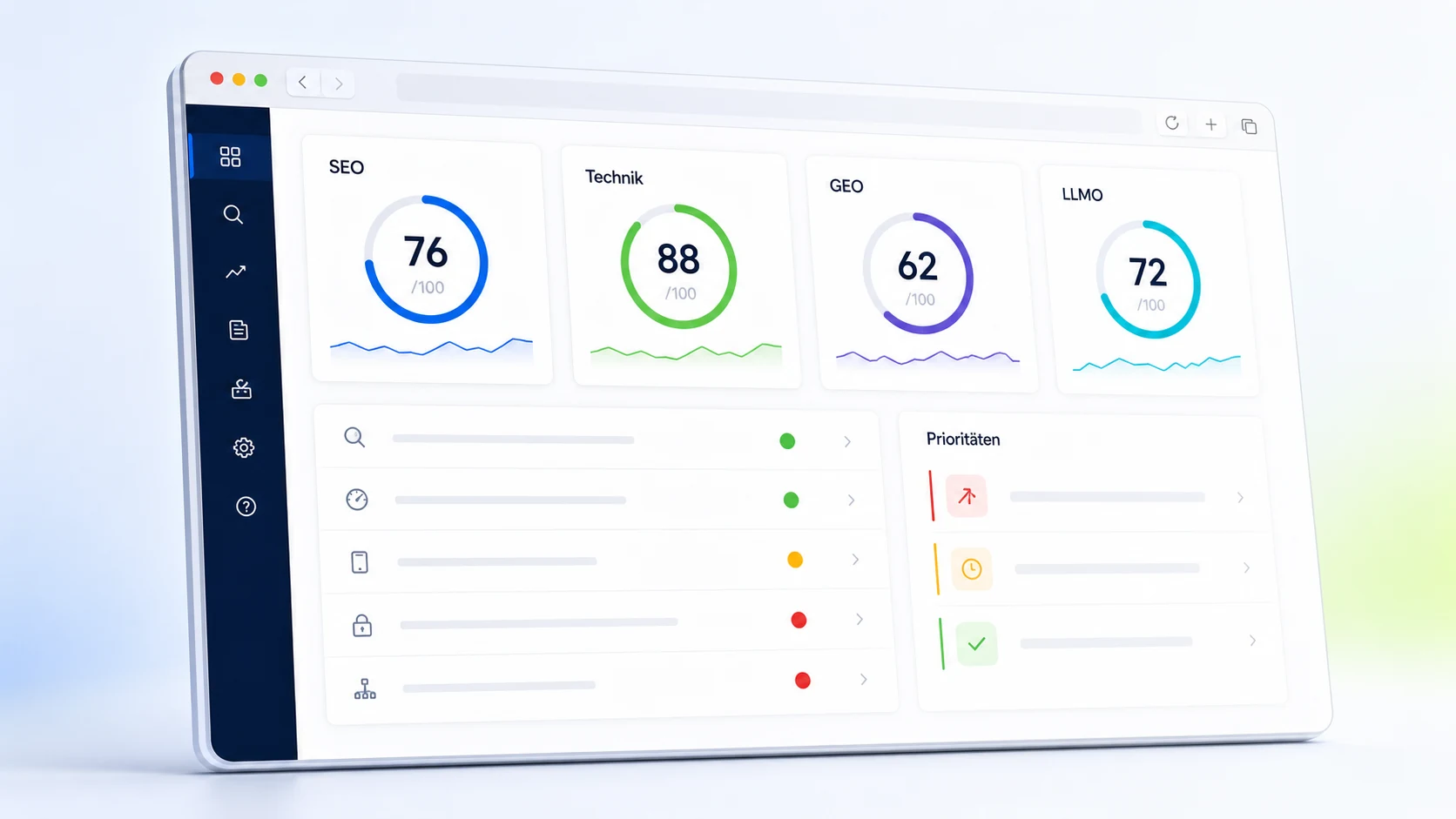
Four clear scores for your website
SEO
SEO means Search Engine Optimisation. The SEO check reviews text, titles, links and images.
Technical
The technical check reviews HTTPS, canonical tags, robots and the sitemap. It also checks the mobile base.
GEO
GEO means Generative Engine Optimisation. The GEO check reviews signals for AI search.
LLMO
LLMO means Large Language Model Optimisation. The LLMO check tests whether AI can read the content clearly.
SCOPE AND VALUE
SEO, GEO, LLMO and Technical check for your website
The audit opens your website live. It checks clear signals. You can see what works. You can also see where a change may help.
SEO check and site health
The check reads your title, text and headings. It tests HTTPS, status, canonical tags, robots and the sitemap. Links, images and the mobile view also count.
GEO check and LLMO check
The check reviews language, data and key names. It tests if the content is easy to follow. Sources, questions and short answers also count. This helps Google and AI.
AI discoverability and clear steps
The preview shows four scores. The PDF report lists every finding. It gives simple steps. You know where to start and what to do next.
The audit connects visible content with the technical signals of the same URL, so titles, headings, internal links, canonical references, sitemaps and structured data can be evaluated together. GEO and LLMO do not represent a secret ranking system; they describe whether public information is consistent enough for search engines and AI services to interpret without avoidable conflicts. The report separates critical errors from useful improvements and therefore provides both a score and a practical order for later implementation.
The four report areas have different purposes and should not be treated as interchangeable percentages. SEO reviews classic search signals, Technical checks the delivery and indexing foundation, GEO considers information used by generative search systems, and LLMO reviews signals that can help language models interpret public content. The important question is still whether the visible page presents one clear topic, consistent provider information and an understandable next action, because technical files cannot repair a page whose main message is unclear.
Each website has a different goal. The audit checks only signals that fit the page. A shop needs different data from a blog. Missing extras are not always a problem. Important errors are marked clearly. This includes a blocked page, a wrong canonical or an HTTPS error. The report explains each finding in plain words. It separates key tasks from small tips. You can improve the site step by step. This helps Google. It also makes the content easier for AI to read. At the end, you have a clear plan for SEO, GEO, LLMO and site health.
How to interpret the audit
An audit is useful only when the scores lead to clear priorities. x25go therefore separates technical foundations, search signals and signals for generative systems. A high score alone is not enough. The key question is whether search engines can fetch the page, understand its content and connect important statements with the right entity. The report orders findings by likely impact and effort. Fix barriers to crawling, indexing or rendering first. Then review content, internal links and signals that help AI systems. Structured data should match visible content. GEO and LLMO do not replace a sound website. They depend on clear pages, consistent facts and reliable sources.
PRACTICAL STEPS AFTER THE AUDIT
How to use the findings
Start with one specific URL – Enter a page address that can be opened in a normal browser. Check that it shows the content a visitor is supposed to see. A home page and a service page serve different purposes, so findings from one URL do not automatically describe an entire domain. When a site has more than one language, check the relevant language version separately. This helps you distinguish a problem shared by all templates from one affecting only an individual page.
Prioritise technical barriers – Begin with problems that prevent a page from loading, being crawled or being indexed. If a useful page cannot be reached, adding more keywords will not solve the underlying issue. Review redirects, canonical addresses, language alternates and internal links next. The canonical URL should refer to the intended page version. Language links should lead to the equivalent content in that language. Once those paths work, you can spend time improving titles, headings and smaller presentation issues.
Compare copy with search intent – A page title should describe its content without making unsupported promises. Read the page as someone searching for the service: Is the offer understandable? Are important questions answered with useful details? Does each link lead to a relevant next step? Short paragraphs and clear wording are better than repeating the same keywords. A low code-to-text ratio may reflect a large amount of HTML markup. By itself, this ratio is not proof of poor content and is not an independent Google ranking signal.
Understand structured data and AI signals – Structured data should describe real information available on the page. JSON-LD is machine-readable page data, not executable inline JavaScript. A technical audit should tell the difference before reporting a scripting warning. For GEO and LLMO, consistent organisation details, clear definitions and verifiable sources help a system understand what the website is about. Even technically valid structured data cannot guarantee that an AI assistant will cite or recommend the site. Those results depend on many factors beyond a site owner’s direct control.
Check links and accessibility – Every link needs a clear purpose. Icon-only controls should have an accessible name through text or a suitable ARIA label. An image link can use meaningful alternative text; adding a screen-reader text node can also help plain-text audits. Check keyboard access, visible focus and menus that can be closed using Escape. A warning in an automated report is a useful starting point, but accessibility also requires hands-on checks with the actual interface and different input methods.
Measure the effect of each change – Before changing anything, record the exact URL and the finding you want to address. Make one related set of changes and check that the page still works. Navigation, mobile layout, checkout or booking actions and important internal links should remain intact. Then run the audit again on the same URL. Comparing the before and after results helps you see which step made a difference. The score is one useful indicator; the main goal is a page that works reliably and answers real visitor questions.